
Procore's AI Agents and DroneDeploy: What Construction Software Is Becoming

Procore's AI Agents and DroneDeploy: What Construction Software Is Becoming

The next construction software platform may not simply help teams document work. It may see the jobsite, connect what it sees to project records, and recommend the next controlled action.
That is the strategic signal behind Procore’s announced agreement to acquire DroneDeploy and its broader push toward construction-specific AI agents.
The important question is not whether contractors should immediately buy more software. The more useful question is this:
What kind of data, governance, and operating discipline will a construction business need when software begins interpreting project conditions: not just storing them?
For owners, contractors, and project leaders, this shift could redefine how teams manage progress, safety, quality, cost, and accountability.
From project-management software to project intelligence
Traditional construction software has primarily helped teams organize information:
- Drawings
- RFIs
- Submittals
- Daily logs
- Schedules
- Contracts
- Inspections
- Cost records
- Photos and videos
That function remains essential. A project cannot be managed well if its records are fragmented or outdated.
But the next stage is more ambitious. Software vendors are now trying to connect operational records with visual and spatial data captured from the field. The objective is to create a more complete picture of what is happening, what has changed, and which decisions may require attention.
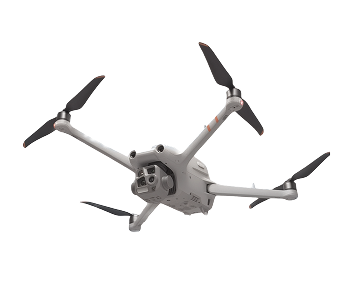
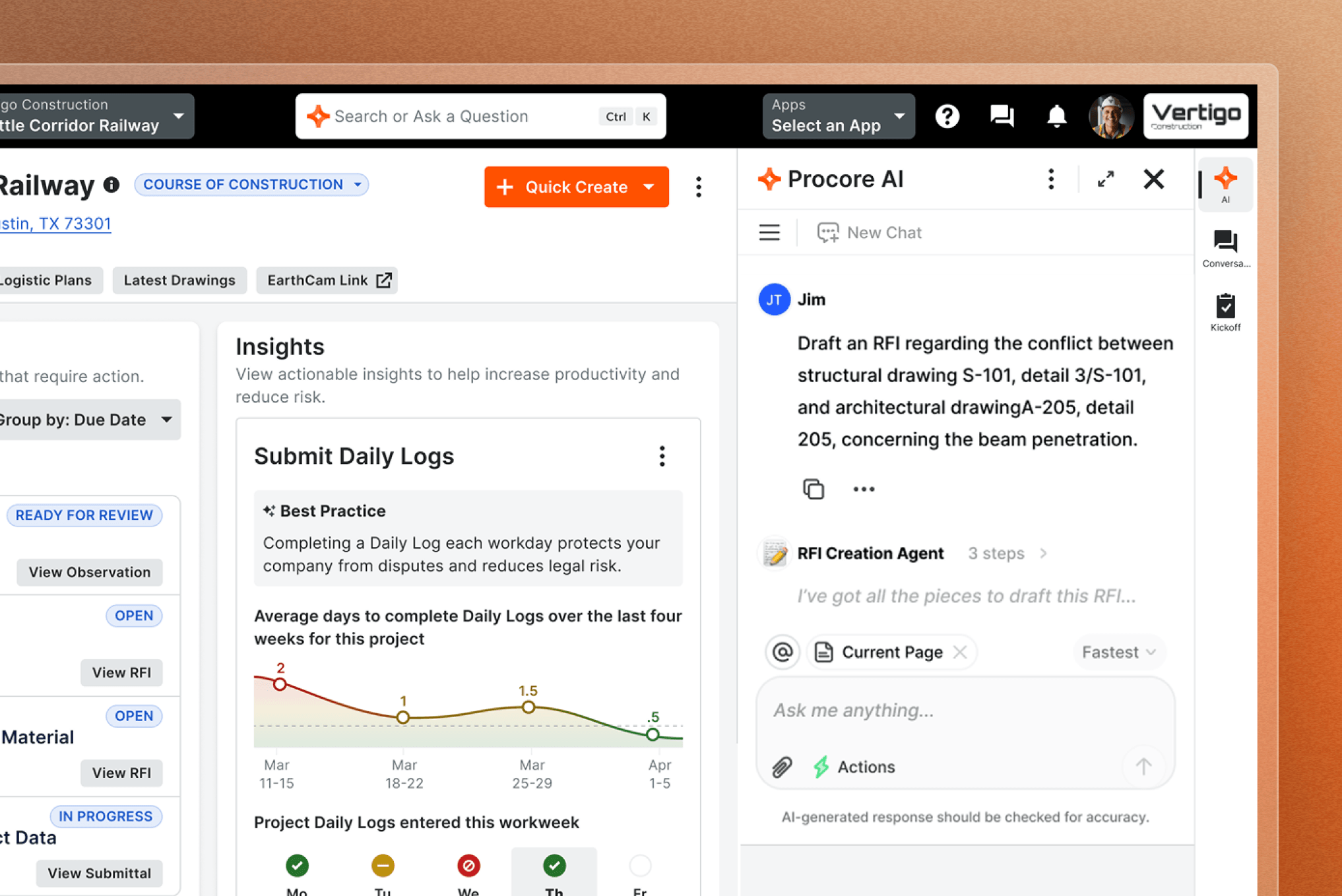
Procore describes its AI direction as construction-native agents that can work across project documents and workflows. DroneDeploy brings reality capture through drones, 360 cameras, robots, and other visual-data sources.
Together, these capabilities point toward a platform that could connect:
- What the project was supposed to be : drawings, specifications, schedules, and contracts
- What the project is becoming : site imagery, scans, models, and progress records
- What the project team must decide next : RFIs, inspections, corrective actions, schedule responses, or approvals
That is a different category from a digital filing cabinet.
The acquisition signal: owning the field-data layer matters
Procore’s proposed DroneDeploy acquisition is significant because DroneDeploy operates close to the point where jobsite data is created.
The platform’s public materials describe visual AI and robotics capabilities across drones, 360 cameras, and robots. These tools can capture site conditions, measure progress, and help identify potential safety or quality issues.
This gives the combined strategy an important architectural direction:
The software platform is moving closer to the field: not only receiving information after a site visit, but helping create structured information from the site itself.
That distinction matters.
A photograph uploaded to a project folder is useful evidence. A time-stamped, location-aware visual record connected to a schedule activity, drawing, inspection, and responsible trade can become operational intelligence.
The difference is not the image alone. The difference is the context surrounding the image.
Why structured data is the real competitive advantage
The ENR article, “Structured Data Positions Contractors to Take Advantage of AI Boom,” makes a practical point: contractors should organize their data before expecting AI to produce reliable value.
That may sound less exciting than announcing a new AI assistant, but it is more important.
Construction businesses generate large volumes of information across the project lifecycle. The challenge is that the information often sits in separate systems, inconsistent naming structures, disconnected spreadsheets, inboxes, PDFs, and informal conversations.
Without structure, an AI tool may be able to summarize documents: but it will struggle to support dependable decisions across the project.
Structured data requires businesses to define:
- Which document is the current source of truth
- How cost codes and work packages are named
- How project activities connect to schedule data
- Which approvals are required before action
- Who owns each workflow
- Which information is confidential
- How field observations are validated
- How changes are recorded and traced
This is why AI readiness is not primarily a software-purchasing exercise. It is an operating-model exercise.
A contractor with clean data and clear approval rules may gain more from a focused AI workflow than a larger contractor with many disconnected tools.
What Procore’s AI-agent strategy could mean
Procore has publicly positioned its AI around construction-native agents that can work with project documents and automate high-volume tasks. Its website also emphasizes maintaining control over actions and approvals.
The ENR source lane reports that Procore has been packaging AI agents and developing governance concepts for managing how those agents operate. Specific package names, availability, regional access, pricing, and capabilities should be confirmed directly with Procore before publication or procurement.
The broader direction is clear even before every product detail is verified.
An AI agent in construction is likely to be most valuable when it performs a bounded operational role, such as:
- Reviewing a defined class of submittals
- Identifying possible drawing or specification discrepancies
- Preparing a draft RFI
- Comparing reported progress with visual evidence
- Organizing inspection findings
- Surfacing schedule risks for human review
- Summarizing project information for an owner or supervisor
The key word is bounded.
A useful construction agent should not be treated as an unrestricted decision-maker. It should operate within a defined workflow, use approved data, show its supporting evidence, and route consequential actions to an accountable human.
The real opportunity is a closed operational loop
DroneDeploy’s visual intelligence can help answer questions such as:
- What work has physically changed?
- Where is progress falling behind?
- Which areas require another inspection?
- What site conditions may create safety or quality concerns?
- Can a reported condition be supported by visual evidence?
Procore’s project-management environment can help connect those observations to:
- Drawings
- RFIs
- Submittals
- Inspections
- Contracts
- Schedules
- Cost management
- Responsible teams
The potential value comes from linking the two.
For example, a visual capture may show that a particular area does not appear ready for the next trade. That observation becomes more useful when the system can connect it to the planned activity, relevant drawing, outstanding RFI, procurement status, and approval owner.
This does not remove the need for a superintendent, project manager, engineer, or owner representative. It can help those professionals spend less time searching for context and more time evaluating what should happen next.
The risk: more data can create more confusion
The construction industry should not assume that adding cameras, drones, robots, and AI agents automatically creates better control.
More data can also produce:
- Duplicate records
- False alerts
- Unclear ownership
- Privacy concerns
- Inconsistent field capture
- Overconfident summaries
- Unapproved workflow actions
- Disputes about whether an image proves a condition
- Additional subscription and implementation complexity
The system must therefore answer four governance questions:
1. What does the system know?
Every AI-generated observation should identify the source, date, location, and relevant project record.
2. What does the system infer?
An identified visual pattern is not automatically a confirmed defect, delay, or contractual noncompliance.
3. Who approves action?
AI may prepare a draft, prioritize an issue, or recommend a workflow. A responsible professional should approve consequential decisions.
4. What becomes the official record?
The business must establish where approved decisions, responses, and changes are recorded.
Without these controls, project intelligence can become another layer of operational noise.
What business owners should learn from this shift
Owners do not need to begin with the most sophisticated AI platform. They should begin by asking whether their project information is visible, connected, and trusted.
Before adopting an AI-enabled construction system, evaluate:
- Whether project documents follow consistent naming and revision rules
- Whether field and office teams update the same system
- Whether schedule, cost, procurement, and quality data can be connected
- Whether the business has clear approval gates
- Whether the vendor explains data security and retention
- Whether the tool provides evidence for its outputs
- Whether a pilot can be measured without exaggerating results
The strongest implementation may start with one workflow: such as progress verification, RFI preparation, or inspection tracking: rather than attempting to automate the entire project lifecycle.
That is how a business moves from experimentation to controlled adoption.
What construction software is becoming
Procore’s AI-agent strategy and DroneDeploy acquisition signal a broader industry transition.
Construction software is moving toward systems that combine:
- Reality capture
- Structured project records
- Construction-specific AI
- Workflow automation
- Human approval
- Portfolio-level visibility
The winners will not necessarily be the companies with the most AI features. They may be the companies that build the clearest connection between field reality, business records, and accountable decisions.
For construction leaders, the strategic priority is not to chase every new tool. It is to build a reliable operating foundation that allows useful tools to work safely.
That means creating a source of truth, standardizing data, protecting sensitive information, training people, testing workflows, and keeping human judgment at the center of consequential decisions.
Are you ready to scale? Is your Enterprise AI-ready?
Explore IGRIS Balteus Construction’s practical, systems-oriented approach to project delivery through our services, Build Smart resources, and project portfolio.
Scale your business with AI. Scale your business with me.
Learn more at https://geromeinocencio.figma.site/.
Source-check section
Status: NEEDS_SOURCE_CHECK
Before publishing, verify the following:
- The exact legal status, closing date, regulatory conditions, and final consideration of Procore’s proposed DroneDeploy acquisition
- Source type needed: Procore and DroneDeploy official transaction announcements, regulatory filings, and closing announcement
- The exact names, availability, packaging, and regional access of Procore’s AI-agent packages
- Source type needed: current Procore product documentation, official release notes, and vendor confirmation
- The number and names of Procore AI agents and any “Skills” or governance-layer features
- Source type needed: official Procore AI documentation and current product materials
- DroneDeploy’s current AI-agent names, supported capture methods, and product capabilities
- Source type needed: official DroneDeploy product pages and documentation
- Any quantitative claims concerning project coverage, labeled safety issues, productivity, savings, rework reduction, or performance
- Source type needed: original vendor methodology, independently reviewed case studies, or clearly attributed customer statements
- Data-security, privacy, retention, and data-use terms for project imagery and AI processing
- Source type needed: current vendor trust centers, contracts, privacy policies, and enterprise terms
Primary research lanes
- ENR: Structured Data Positions Contractors to Take Advantage of AI Boom
- Procore
- Procore AI
- Procore platform
- DroneDeploy
- DroneDeploy acquisition announcement
- Construction Dive: Procore’s DroneDeploy acquisition
- McKinsey: How AI is reshaping the future of the AEC industry
ChatGPT Work banner prompt
Create a premium editorial LinkedIn article banner about the evolution of construction software from project documentation to project intelligence. Show a realistic active commercial construction site viewed from an elevated perspective, with a surveyor or site professional reviewing a tablet in the foreground and a drone or 360-degree reality-capture device operating in the middle distance. Integrate subtle, realistic overlays: not futuristic cyberpunk: showing a site map, time-stamped progress markers, drawing references, inspection annotations, schedule links, and a human approval checkpoint. The visual should communicate that field imagery is being connected to structured project data and controlled workflows. Use authentic construction materials, safety-compliant PPE, natural daylight, realistic shadows, tactile concrete and steel textures, and strong spatial depth. Apply IGRIS Balteus brand colors: Primary Navy
#0D2040, Deep Navy#002147, Teal#0D9488, Copper#B87333, Secondary Blue#365D8A, and light background accents#EDF2F8and#FFFFFF. Use Montserrat for any short headline and Lora only for a restrained accent phrase. Headline option: “From Site Capture to Project Intelligence.” Do not use fabricated Procore or DroneDeploy logos, fake product screens, robotic workers, glowing holograms, cyberpunk styling, unsupported performance claims, or identifiable private individuals. Format: 16:9, high-fidelity professional commercial photography with restrained AI-native data overlays.